

Our long-term holding ETF portfolio consists of the following ETFs:

Dividends:
DIVO: Amplify CPW Enhanced Dividend Income ETF
IDVO: Amplify CWP International Enhanced Dividend Income ETF
GPIQ: Goldman Sachs Nasdaq-100 Premium Income ETF
Capital Gains:
GRNY: Fundstrat Granny Shots US Large Cap ETF
SPMO: Invesco S&P 500 Momentum ETF
VFLO: VictoryShares Free Cash Flow ETF
Diversification:
DBEF: Xtrackers MSCI EAFE Hedged Equity ETF
CORO: iShares International Country Rotation Active ETF
HGER: Harbor Commodity All-Weather Strategy ETF
Relative Performance
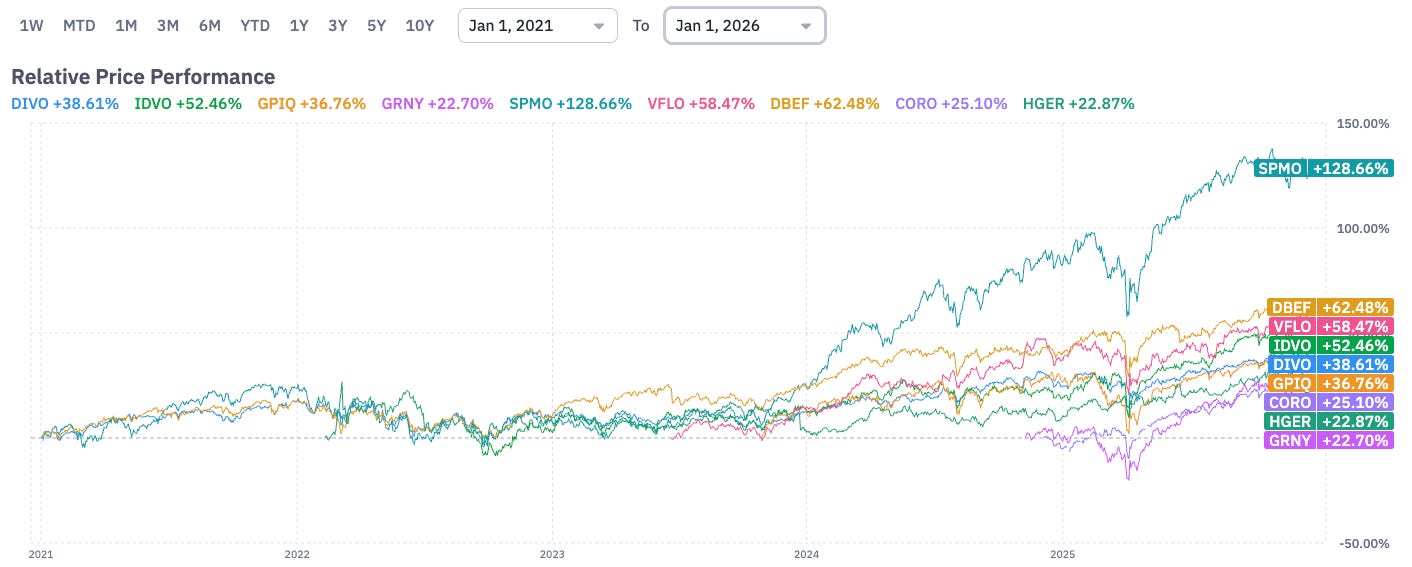
Price performance comparison of these ETFs versus “the market” SPY ETF for the 5 year period from 2021-Jan-01 to 2026-Jan-01:
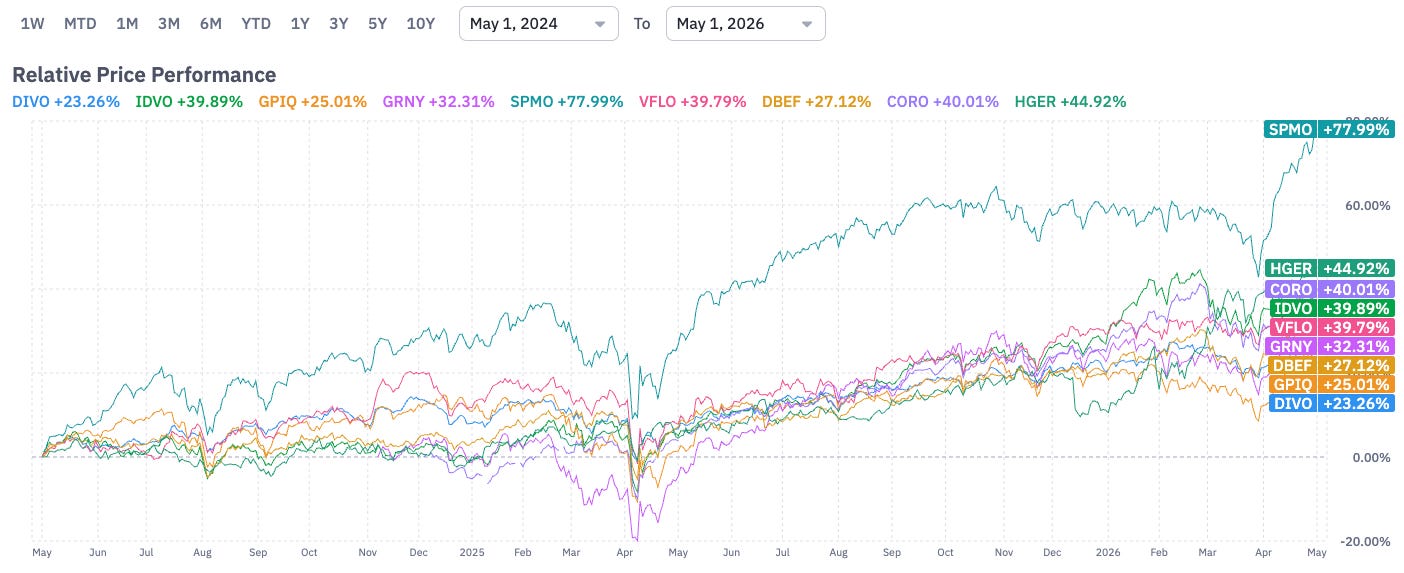
And for the 1 year period between 2025-May-01 and 2026-May-01:
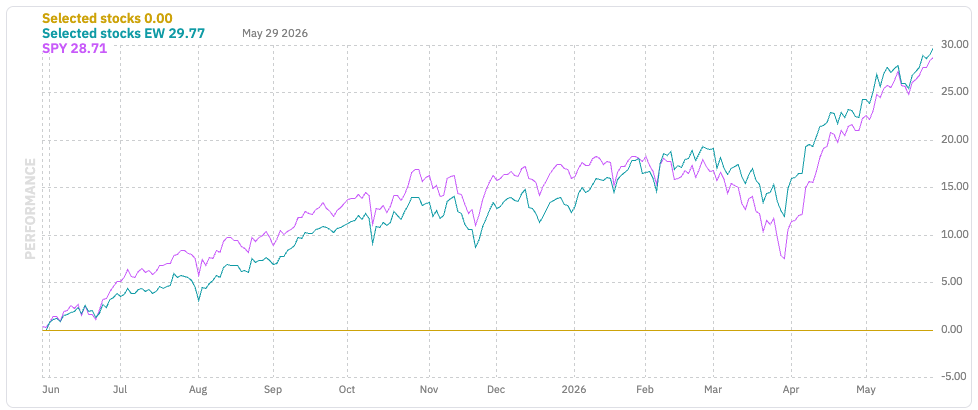
Selected stocks vs. SPY
We can categorize these ETFs into groups:
Dividend Gains Group: DIVO, IDVO & GPIQ
DIVO focuses on high-quality, dividend-paying blue chips from the S&P 500. DIVO is actively managed and uses a two-pronged approach to build its “income engine”:
The Core (Dividend Growth): The fund managers hand-pick 20 to 25 “blue-chip” stocks (like Microsoft, JPMorgan, and Chevron). These are companies with strong earnings and a history of increasing their dividends. This provides a baseline yield of around 2%–3%.
The Tactical Overlay (Covered Calls): Unlike “mechanical” funds that sell options on everything all the time, DIVO is tactical. They only sell call options on individual stocks when the managers see an opportunity (high volatility or a stock looking “overbought”). This adds an extra 2%–4% in yield.
DIVO doesn’t just chase yield; it wants the stock prices to go up, too. By only writing options on a small portion of the portfolio (usually 20%–30%), it leaves a lot of room for capital gains.
IDVO uses the exact same strategy as DIVO but applies it to international stocks (outside the US). IDVO follows the same “Core-plus” formula as DIVO, but the pond it fishes in is different:
The Core (Global Quality): It holds 30–50 high-quality international companies via ADRs (American Depositary Receipts). These are huge, household names from Europe, Asia, and Canada—think Taiwan Semiconductor (TSMC), Alibaba, Nutrien, or Shell.
The Tactical Overlay: Just like DIVO, the managers don’t sell options on everything. They selectively write covered calls on individual international stocks to boost the yield when they see a good opportunity.
International stocks generally pay higher dividends than US stocks to begin with. When you add the covered call income, IDVO often targets a yield in the 5%–7% range.
GPIQ employs a “Core-plus” strategy that balances two main components:
The Core (Equity Exposure): It invests at least 80% of its assets in the companies that make up the Nasdaq-100. This gives exposure to the growth of large-cap tech and innovation companies.
The Premium (Options Overlay): The fund managers “write” (sell) call options on the index. This generates premium income, which is then paid out to shareholders as monthly distributions.
Unlike some “mechanical” competitors that sell options on 100% of their holdings, GPIQ typically writes options on 25% to 75% of the portfolio. This flexibility allows it to capture more of the market’s upside during “bull” runs.
Capital Gains Group: GRNY, SPMO & VFLO
GRNY is built for aggressive growth. It is the flagship ETF of Tom Lee, a well-known market strategist from Fundstrat who is famous for his bullish calls on the S&P 500 and Tech. The fund’s managers consider large-cap U.S. companies to be those companies with a market capitalization of greater than $10 billion or more. The fund doesn’t just track an index; it uses a proprietary “thematic” selection process:
Theme Integration: Fundstrat identifies several major market themes (e.g., AI/Automation, Millennial spending, Energy security, or easing financial conditions).
The “Sweet Spot”: A stock only gets into the ETF if it appears in at least two of these different investment themes at the same time. It holds a concentrated portfolio (typically 40–50 stocks).
Active & Equal-Weighted: The fund is actively managed and rebalanced quarterly. Instead of being dominated by just Apple or Microsoft, it keeps its holdings relatively equal-weighted to find growth across the board.
GRNY is one of the best examples of “outsourcing”. Fundstrat is highly transparent about the management of their ETFs. Granny Shots
SPMO is a “smart beta” fund. Its core philosophy is simple: Stocks that have been going up tend to keep going up. SPMO doesn’t care about a company’s story or its dividends. It only cares about its Momentum Score.
Selection: It looks at all 500 companies in the S&P 500 and measures their price performance over the last year (ignoring the most recent month to avoid short-term “noise”).
Volatility Adjustment: It adjusts that performance for risk. A stock that went up 20% steadily is ranked higher than a stock that went up 20% in a wild, zig-zagging fashion.
The Top 100: It takes the 100 stocks with the highest scores and weights them by a combination of their market cap and their momentum.
Rebalancing: It does this twice a year (March and September). This means it “recycles” its portfolio—selling the winners that have started to cool off and buying the new leaders.
In strong bull markets, SPMO often crushes the standard S&P 500 because it leans heavily into whatever is working. Because it follows the “hot hand,” its sector exposure changes wildly. One year it might be 50% Tech; a year later, it could be 50% Energy if oil prices are skyrocketing. Momentum works great until it doesn’t. When the market suddenly “rotates” (e.g., people sell Tech to buy Banks), SPMO can drop much faster than the broad market because it is packed with the very stocks everyone is exiting.
SPMO adds “Momentum” to our portfolio. Understanding Momentum
VFLO is a “quality-value” powerhouse, VFLO is about profitability and cold, hard cash. It focuses on companies that generate more cash than they know what to do with—a metric many professional investors consider the “truth” behind a company’s health.
VFLO uses a strict, rules-based process to filter the U.S. large-cap market (the Russell 1000):
Profitability Filter: It throws out companies that aren’t consistently profitable.
Free Cash Flow (FCF) Yield: It ranks the remaining companies by their FCF Yield (Free Cash Flow divided by Enterprise Value). Essentially, it’s looking for companies that are “on sale” relative to the amount of cash they produce.
Growth Score: From that “cheap” list, it picks the 50 companies with the best growth prospects (looking at trends in sales and earnings).
Quarterly Rebalance: Because cash flow can change fast, the fund resets every three months to ensure it only holds the top cash-generators.
By focusing on FCF yield, VFLO naturally avoids “hype” stocks that have high prices but no actual profits. Unlike many value funds that get stuck in dying industries, VFLO’s focus on cash flow and growth often leads it into Energy, Health Care, and Tech. Historically, companies with high free cash flow have tended to outperform the broader market with less risk over long periods.
VFLO adds quality stocks to our portfolio. What is FCF?
Diversification: DBEF, CORO & HGER
DBEF: While IDVO (which we discussed earlier) uses an active strategy to generate income from international stocks, DBEF is a passive index fund that focuses on “hedging” away the risk of foreign currencies.
When you buy a standard international fund, you have two risks: the stock prices going down and the foreign currency (like the Euro or Yen) getting weaker against the Dollar. DBEF removes the second part:
The Core (EAFE Exposure): It tracks the MSCI EAFE Index, which includes roughly 800 large and mid-cap companies across Europe, Australasia, and the Far East (Japan, UK, France, Germany, etc.).
The Hedge: The fund uses financial contracts (currency forwards) to “neutralize” the impact of currency fluctuations.
If the Euro drops, a normal international fund loses value. DBEF is protected.
If the Euro rises, a normal international fund gains extra value. DBEF misses out.
CORO is an actively managed ETF that doesn’t just “own the world” in a static way. Instead, it dynamically rotates its exposure across different non-U.S. countries (both Developed and Emerging Markets) based on where the momentum and economic strength are highest. It essentially bets on the “winning countries” rather than holding a fixed percentage of every nation. BlackRock’s investment team dynamically shifts the portfolio into different single-country iShares ETFs (like those for Japan, Brazil, or Germany) based on their proprietary macro research and valuation models.
HGER provides exposure to a diversified basket of physical commodities (like energy, metals, and agriculture). What makes it “All-Weather” is its selection process: it picks commodities based on their inflation sensitivity and technical trends. It’s designed to perform well when the cost of living (and materials) is rising. HGER ensures that while companies struggle with rising costs, HGER commodity holdings are likely profiting from those same rising prices.
Portfolio Distribution
Following our simplicity principle, we will allocate the same amount of capital to each ETF. On an imaginary $100,000 portfolio, we would allocate approximately $10,000 to each position.
Optionally, you can allocate more funds to the dividend or to the growth group depending on your priorities. DBEF can be avoided if you consider that IDVO is already exposing you to international stocks enough.
Portfolio Management: The Power of Strategic Inactivity
The ultimate goal for this portfolio is simplicity. We aim to make as few adjustments and trades as possible. By activating automatic dividend reinvestment, we allow the portfolio to compound interest quietly in the background, letting “our money make money.”
We will manage our positions following a simple set of rules:
Tactical Reinvestment: In our weekly reviews, we will identify moments where the market presents a low-risk, high-reward entry point. When these opportunities arise, we will deploy our cash reserve to increase our positions.
Continuous Scaling: As we generate additional capital through our primary careers or other investments, we will funnel those funds into this portfolio. We will increase our positions whenever we have additional funds but always keeping at least 20-10% cash reserve.
Disclaimer: The content on AMAT Investing is strictly for educational and learning purposes. The author is not a licensed financial advisor and holds no formal financial education. This post does not constitute professional financial advice. All investing involves risk of loss. Always conduct your own research and consult a licensed professional before making any investment decisions.